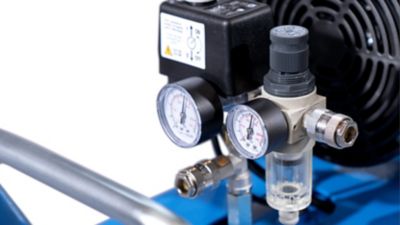



Oil viscosity determines how well the lubricant forms a protective film between moving parts. In high temperatures, oil can become thinner, reducing film strength, heat transfer and component protection. Using the correct viscosity grade helps maintain reliable compressor operation.
Compressor Lubrication in Hot Environments: Viscosity, Oil Changes and Warning Signs
High ambient temperatures can significantly influence the performance of air compressors. While cooling systems and ventilation are often the focus, lubrication is just as critical, especially in oil-injected compressors.
When temperatures rise, oil viscosity, change intervals, and alarm signals become tightly interconnected, directly affecting reliability, efficiency, and system lifetime. In addition, incorrect lubrication under high-temperatures conditions can increase energy consumption, maintenance frequency, and total cost of ownership.
Understanding these interactions helps operators reduce downtime and maintain stable performance in demanding conditions.
Different lubricant technologies also respond differently to heat. Mineral oils, semi-synthetic, and full synthetic lubricants vary in their resistance to oxidation, viscosity loss, and aging, making the correct lubricant type selection essential for consistent performance in high-temperature conditions.
Table of Contents
- Why Lubrication Matters More in High Temperatures
- Viscosity: the Key Parameter Under Thermal Stress
- Viscosity Stability: Why the Viscosity Index Matters
- Oil Change Intervals: Heat Accelerates Degradation
- Understanding Alarms: Early Indicators of Lubrication Problems
- When to Consider Upgrading Your Lubricant
- Best Practices for Air Compressors in Hot Environments
- Conclusion
- Common Questions About Oil and Lubrication in Heat
Why Lubrication Matters More in High Temperatures
Lubrication is not only about reducing friction. In air compressors, oil also:
- Transfers heat away from compression elements
- Seals clearances between moving parts
- Protects components from wear
These functions depend on both oil condition and viscosity. When temperatures increase, oil degrades faster and its ability to perform these functions declines.
If lubrication performance drops, internal temperatures tend to rise further, creating a cycle that can lead to inefficiency and component damage.
Viscosity: the Key Parameter Under Thermal Stress
Viscosity defines how oil flows and how effectively it maintains a protective film between metal surfaces.
In real compressor operation:
- Low viscosity (too thin oil) reduces lubrication film thickness, increasing wear risk
- High viscosity (too thick oil) restricts flow, reduces cooling efficiency, and increases energy consumption
Temperature directly drives these changes:
- As temperature rises → viscosity decreases (oil becomes thinner)
- As temperature drops → viscosity increases (oil becomes thicker)
In hot operating environments, the main risk is excessive thinning. When oil becomes too thin:
- Film strength is reduced
- Heat transfer becomes less effective
- Internal components may experience increased contact and wear
Internal documentation confirms that incorrect viscosity also reduces the oil’s ability to dissipate heat, further increasing system temperatures.
In practice, this means using a lubricant with the viscosity grade recommended by the manufacturer, while ensuring stability at elevated temperatures. Even small deviations from the specified range can negatively affect cooling efficiency and component protection.
Viscosity Stability: Why the Viscosity Index Matters
Not all lubricants react equally to temperature changes. The viscosity index (VI) defines how stable the oil remains across a temperature range.
- High VI oils: more stable, less affected by temperature
- Low VI oils: more sensitive, stronger viscosity fluctuations
In global applications, where compressors may operate in hot climates or fluctuating conditions, high VI lubricants help maintain consistent performance.
Lubricants with a high viscosity index, often synthetic formulations, deliver more stable performance across temperature ranges. This results in improved protection under thermal stress, more consistent operation, and reduced performance variation compared to standard mineral oils.
Internal material shows that stabilizing viscosity is essential to ensure:
- Proper lubrication at high temperatures
- Good flow at start-up
- Protection of internal components across conditions
Oil Change Intervals: Heat Accelerates Degradation
Oil does not degrade at a constant rate. In high-temperature environments:
- Oxidation accelerates
- Additives break down faster
- Contamination has a stronger impact
This means oil change intervals become more critical and often shorter.
When oil is not replaced on time, the risks include:
- Reduced cooling capability
- Increased wear
- Higher oil carryover
- Greater likelihood of alarms and shutdowns
Fresh oil is essential to maintain:
- Stable lubrication
- Effective heat removal
- Proper sealing of compression elements
Industry practices indicate that oil change schedules depend on operating hours and conditions, with high temperatures typically requiring tighter maintenance intervals.
Understanding Alarms: Early Indicators of Lubrication Problems
Modern air compressors include monitoring systems designed to detect deviations early. In hot conditions, lubrication-related alarms are particularly relevant.
High temperature alarms
These are often the first sign of lubrication issues.
When oil performance drops:
- Heat dissipation decreases
- Internal temperatures rise
- Oil degradation accelerates
This creates a feedback loop where high temperature worsens oil condition, and degraded oil increases temperature further.
In practice, recurring temperature alarms are not always solely linked to cooling capacity. they can also indicate degraded oil condition or the use of an unsuitable lubricant.
Low oil level warnings
Low oil alarms can result from:
- Extended oil change intervals
- Leaks
- Oil carryover into the air system
Operating with insufficient oil reduces lubrication efficiency and can quickly lead to mechanical issues or shutdowns.
Viscosity monitoring and alarm thresholds
Monitoring oil condition goes beyond temperature alone. Viscosity changes are often an early indicator of problems such as:
- Oxidation
- Contamination
- Oil dilution
Industry practices show that even small deviations from baseline viscosity are significant and may trigger investigation or maintenance actions.
When to Consider Upgrading Your Lubricant
In certain operating conditions, switching to a higher-performance lubricant may be beneficial. This can be particularly relevant when:
- Compressors operate continuously in high ambient temperatures
- Temperature-related alarms occur frequently
- Oil change intervals need to be reduced significantly
- Energy consumption increases due to thermal inefficiencies
In such cases, a more thermally stable lubricant can help maintain perfromance and improve reliability.
Best Practices for Air Compressors in Hot Environments
To ensure reliable operation in high-temperature conditions:
- Use lubricants with the correct viscosity grade and a high viscosity index
- Adapt oil change intervals based on real operating conditions, not only running hours
- Monitor temperature trends in relation to oil condition
- Respond early to warnings instead of waiting for shutdown conditions
Lubrication should be considered a core operational parameter, not just a maintenance activity.
Conclusion
In hot environments, lubrication becomes a decisive factor in compressor performance.
Viscosity, oil condition, and alarm signals are all interconnected:
- Viscosity determines lubrication quality
- Temperature influences viscosity and accelerates oil degradation
- Change intervals define how well the system adapts to these stresses
- Alarms provide critical early warning signals
By selecting the appropriate lubricant technology and managing viscosity, oil change intervals, and alarms together, operators can improve equipment reliability, optimize efficiency, reduce lifecycle costs, and maintain stable performance—even under demanding conditions.
Common Questions About Oil and Lubrication in Heat
If compressor oil becomes too thin, it may not provide enough separation between internal components. This can increase wear, reduce cooling efficiency and raise the risk of overheating or temperature-related alarms.
Yes. High operating temperatures accelerate oxidation, additive breakdown and oil aging. As a result, compressors working in hot environments may require shorter oil change intervals than units operating in moderate conditions.
Yes. An unsuitable lubricant can affect viscosity, cooling efficiency and oil stability. This may contribute to higher internal temperatures, low oil level warnings, increased oil carryover or recurring alarm conditions.
The viscosity index indicates how stable an oil’s viscosity remains as temperature changes. A higher viscosity index means the lubricant is less affected by temperature fluctuations, helping maintain consistent protection in demanding conditions.